
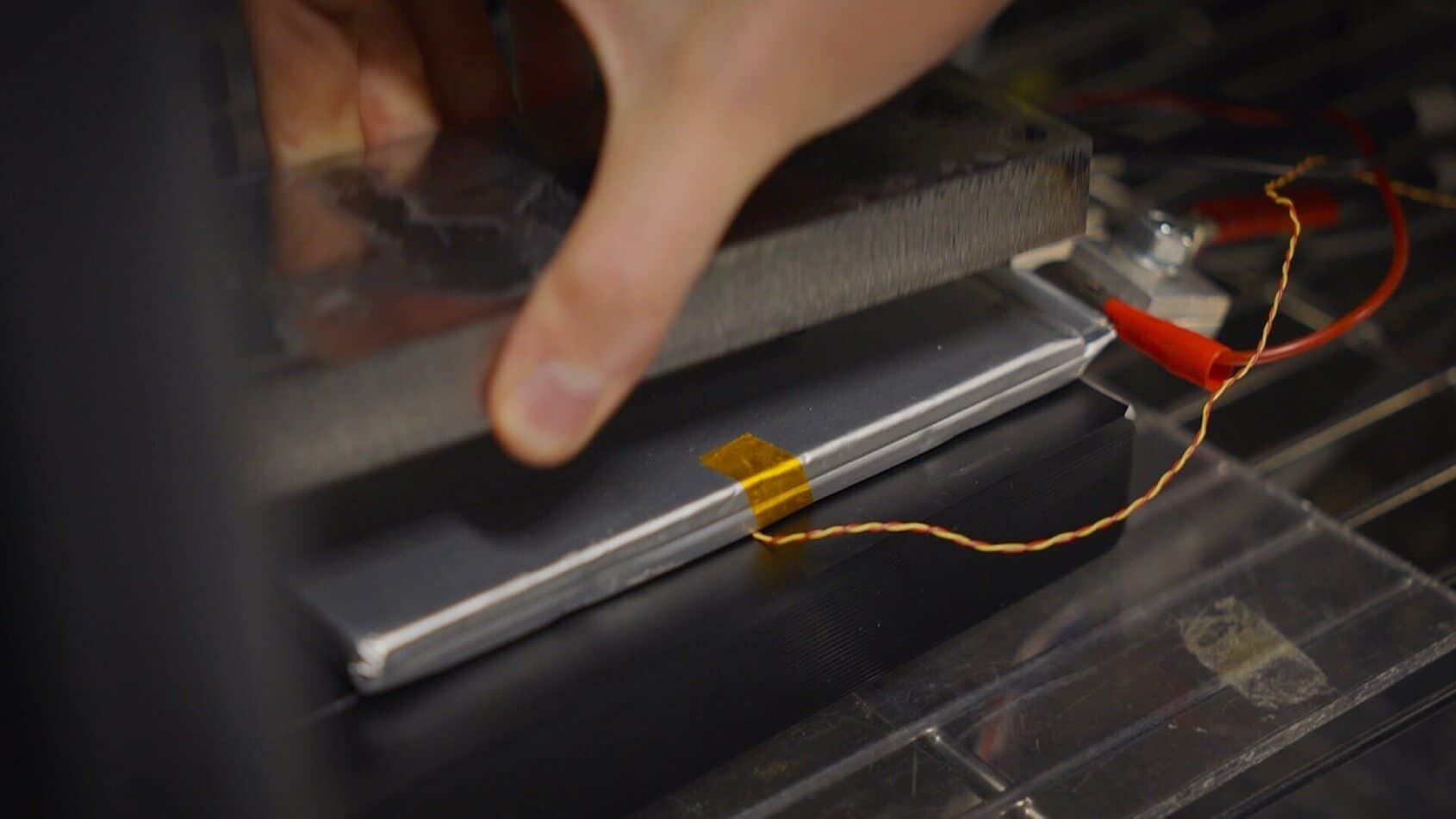
Donut Lab has commissioned the internationally renowned VTT Technical Research Centre of Finland to measure the properties of the world’s first solid-state battery ready for production vehicles developed by the company under independent research conditions. The test, which measured the battery’s performance at high temperatures, demonstrates that the Donut Battery withstands heat extremely well and offers even greater capacity at high temperatures.
Technology company Donut Lab has today published the results of the second test measuring the properties of its solid-state battery. The test evaluated the capacity performance of the battery cell in hot conditions. The report is available for download on the I Donut Believe website.
“Traditional lithium-ion batteries are very sensitive to heat, and their upper operating temperature limit is typically around 60 to 70 degrees Celsius. High temperatures increase the risk of damage to battery cells and shorten their service life. High temperatures can also cause accelerated reactions inside the cell, and in the worst case, the risk of thermal runaway increases significantly. For the Donut Battery, the baseline situation is already quite different, as it does not contain flammable liquid electrolytes, which is why the maximum operating temperature is higher,” explains Ville Piippo, CTO at Donut Lab.
Battery cell tested at temperatures of 80 and 100 degrees Celsius
The setup for the test was straightforward: a battery cell was placed on an aluminium profile and a steel plate placed on top of the cell, designed to apply light pressure, hold the cell in place and reduce so-called hot spots. The capacity of the Donut Battery was measured in stages using this setup at temperatures of both 80 and 100 degrees Celsius.
The test began with a standard 1C discharge test to a cutoff of 2.7 volts, which determines the nominal capacity of the cell at room temperature. The cell was then charged back to the original 4.15 volts, the temperature of the test chamber raised to 80 degrees, and the cell kept there for two hours to stabilise its temperature.
After this, the same 1C discharge test was repeated to obtain a high temperature reference value. The chamber was cooled and the cell kept there for one hour to allow it to cool completely. The battery cell was then recharged to 4.15 volts. After an hour of rest, the cell was discharged at 12 amps to the same cutoff point of 2.7 volts, which defined the nominal 0.5C capacity at room temperature.
The battery was then charged back to 4.15 volts, after which the cell temperature was allowed to equilibrate for an hour and the chamber temperature was raised to 100 degrees. After the battery cell temperature had been allowed to equilibrate for two hours, the same 0.5C discharge test was repeated. Finally, the chamber temperature was lowered back to 20 degrees and the battery charged back to 4.15 volts to ensure that it still reached the same charge capacity.
Significantly better results than previous reported
The test results demonstrate that the Donut Battery performs even better under high temperature stress than previously reported. In the 80-degree test, the battery cell was able to utilise up to 110% of its capacity with better efficiency than at room temperature. This is because the internal resistance of the cell is lower at high temperatures, which means that the voltage drop during discharge is lower than at room temperature. The battery also continued to function completely normally after the test, with no visible changes.
In the 100-degree test, the Donut Battery was able to utilise approximately 107% of its capacity with better efficiency than at room temperature. It also charged back to 4.15 volts with the same charge capacity as at room temperature. The battery and its active materials were still fully functional even though the cell’s external pouch had lost its vacuum at 100 degrees.
“The battery’s full capacity was utilised with excellent results at both 80 and 100 degrees Celsius, and it was possible to discharge it at a 1C discharge rate at 80 degrees and a 0.5C discharge rate at 100 degrees without any increase in temperature. The battery’s properties did not change even at 100 degrees, and it functioned normally when recharged, which demonstrates the convincing performance of the Donut Battery even in extremely hot conditions. This confirms that the battery is exceptional not only in terms of performance but also in terms of safety,” Piippo states.
The full VTT test report can be downloaded from the I Donut Believe website.


