
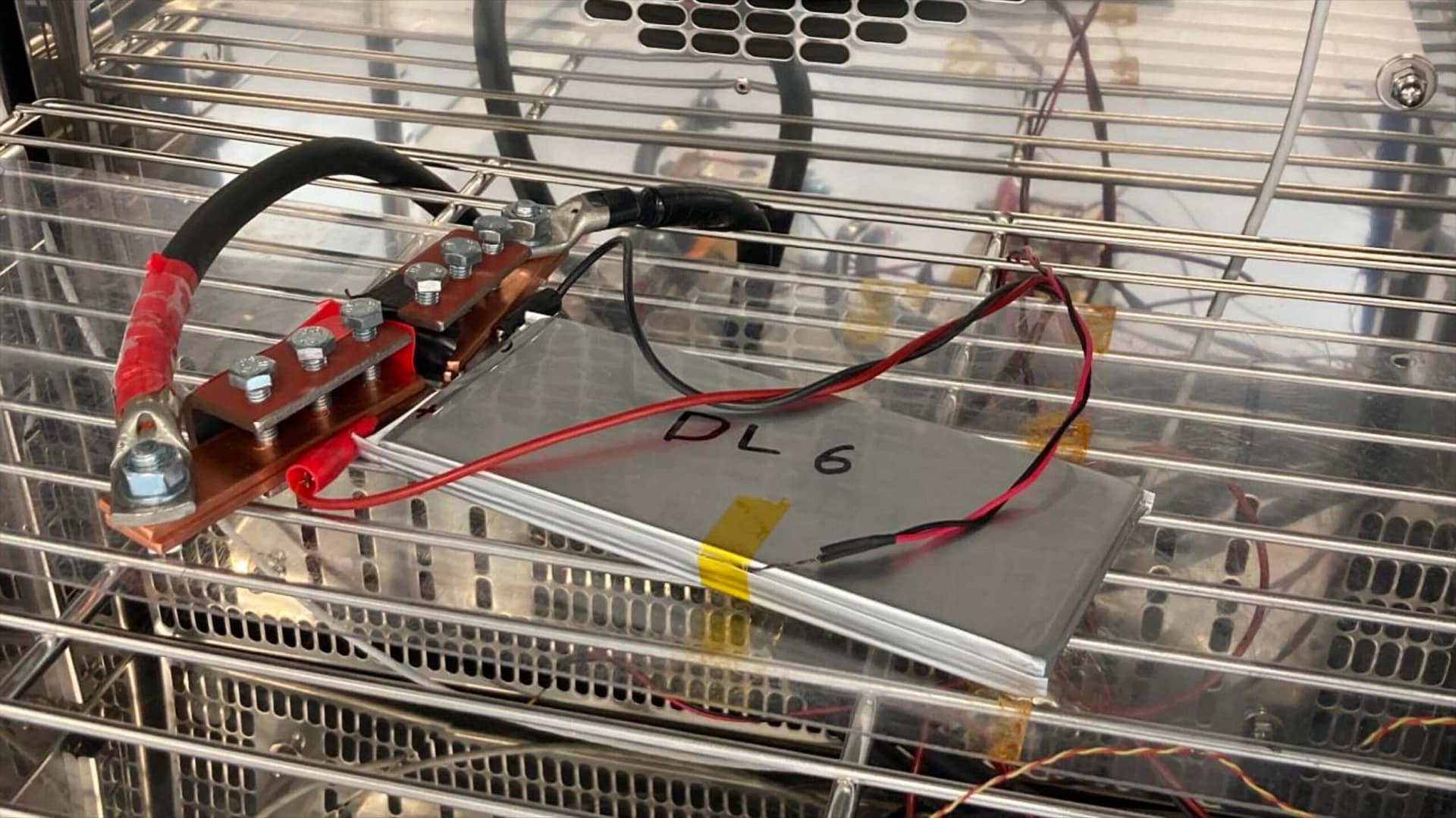
Technology company Donut Lab has today published new test results. According to the report by the research organisation VTT, the Donut Battery achieved an energy density of 409 watt-hours per kilogram and 805 watt-hours per litre.
“This was a fairly straightforward test, as energy density consists of two things: how much energy a battery cell holds and how much it weighs or takes up space. The test used a battery cell with the same chemistry as in VTT’s previous tests, only energy optimised as part of our broader development work,” says Ville Piippo, CTO at Donut Lab.
At the start of the test, the cell was weighed and measured. The battery was then fully charged and discharged at 25 degrees Celsius using the entire voltage range of the cell – this was used to determine how many watt-hours could be extracted from the cell. Dividing energy by mass gives thev gravimetric energy density of the battery. Dividing energy by volume gives the volumetric energy density.
Tailored battery solutions for different industries
“Today’s test result and the other features that were demonstrated this spring not only show that the Donut Battery is an exceptional innovation. They also reflect the limitless possibilities of our technology, which we can increase with relatively light optimisations. After the launch, we have focused on manufacturing the next generation of cells, and we plan to scale their production to an industrial level,” says Marko Lehtimäki, CEO of Donut Lab.
Donut Lab’s customer base is diverse and ranges from vehicles to drones and battery energy storage systems.
“Our key goal is to develop battery solutions that meet the technical needs of each customer. Instead of a single standardised battery, we develop tailored variations of the same material and continuously optimise the technology so that it is suitable for the requirements of different industries. To support our development work, we have also wanted to identify several different actors for testing and verifying our technology,” Lehtimäki continues.
Intertek confirms the bipolar structure of the next-generation battery cells
Donut Lab has also launched third-party research into the next generation of its battery technology cells, in collaboration with the international testing and certification company Intertek. The company examined the cell’s internal architecture, which confirmed the cell’s bipolar structure.
In its structural examinations, Intertek found multiple electrochemical layers connected in series inside a single cell. Split metal foils act as electrodes on both sides of the layers. This is a bipolar cell structure, where a higher voltage is generated inside the cell by layers connected in series, rather than separate cells being connected in series externally.
“A bipolar cell structure is possible only with a solid electrolyte. Any liquid would seep between the layers and allow ions to flow to the wrong places. This is why bipolar cells are not made with liquid electrolytes. This ultimately proves that our batteries are solid-state,” Piippo explains.
“The production of bipolar cells is in itself as big a leap as the transition from standard lithium-ion batteries to solid-state ones. Bipolar cells open up possibilities that were previously unfeasible – they maximise the energy density of battery packs and minimise their structural complexity and cost,” Lehtimäki adds.
Nail penetration test demonstrates safety of battery cell
Intertek also performed a nail penetration test on Donut Lab’s next-generation battery cell to evaluate the cell’s behavior in a severe mechanical damage scenario. In the test, a steel nail was driven through a fully charged battery cell and left in the cell for an hour to simulate a permanent internal short circuit.
In a typical lithium-ion battery with a liquid electrolyte, this is a worst-case scenario. The short circuit discharges energy to a single point, the temperature rises, the liquid electrolyte is flammable, and the cell can undergo thermal runaway, causing smoke, fire and even an explosion. In the test conducted by Intertek, the Donut Lab battery cell remained completely stable throughout the hour-long monitoring.
“The nail penetration test proves in its simplicity that our battery is very safe. Safe cells also make construction simpler, lighter and more cost-effective at the battery pack level,” Piippo summarises.
VTT’s and Intertek’s test reports are available at Idonutbelieve.com.


